
Understanding the role of iron in ecoprinting
If there is one ingredient that can dramatically change the outcome of an ecoprint, it is iron.
Iron has been used in natural dyeing for centuries, where it is primarily known as a color modifier. In ecoprinting, however, its role extends far beyond simply darkening colors.
Iron influences color, contrast, detail, print definition and even the overall mood of a print. Understanding how it works is therefore an important step toward working more intentionally with your prints.
Why iron creates more defined ecoprints
One of the reasons many ecoprinters use iron is its ability to enhance fine detail. Iron reacts strongly with tannins naturally present in many plants. This reaction often creates darker and more distinct impressions, allowing fine veins, stems and botanical structures to become more visible within the print.
This is why two otherwise identical ecoprints can look surprisingly different depending on whether iron is present or not. Without iron, many prints appear as delicate silhouettes of the plant against the background color. In some cases, particularly when no background dye is used, the impressions may be so subtle that they are barely visible.
With iron, the same print often gains contrast, definition and visual depth. Delicate plant structures become easier to see, and the overall print typically appears more refined and clearly defined.
Iron as a color modifier in ecoprinting
In natural dyeing and ecoprinting, iron is often referred to as a saddening agent because it tends to shift colors toward darker and more muted tones. Bright yellows may become olive green. Orange tones may deepen toward rust. Pinks and reds may shift toward burgundy, brown or plum.
These color changes occur because iron interacts with both plant pigments and tannins, creating new color complexes. The exact result depends on the plants, dyes and fibers involved.
This ability to modify color is one of the reasons iron remains such an important tool in both natural dyeing and ecoprinting. Even small adjustments in iron concentration can dramatically alter the final appearance of a print.
Types of iron used in ecoprinting
Iron is available in several forms, each with its own characteristics and potential applications in ecoprinting.
Iron sulfate (FeSO₄) is by far the most widely used form of iron in both natural dyeing and ecoprinting. It is stable, easy to store and allows for precise and repeatable measurements, making it an excellent choice when consistency is important.
Another variant is iron lactate (C₆H₁₀FeO₆). It is known to produce slightly different tones, particularly in natural dyeing, compared to iron sulfate. However, in my own ecoprinting experiments, I have not yet been able to achieve the results I am looking for, with this type of iron.
Iron acetate (Fe(C₂H₃O₂)₂) is another option and is often considered gentler on fibers. However, it can be more challenging to store, due to its limited shelf life.
Alternatively, iron water can be made by soaking iron-containing objects or steel wool in water. While this can be an accessible way of introducing iron into the printing process, the concentration often varies considerably from batch to batch. As a result, it can be difficult to achieve consistent and repeatable results.
For this reason, iron sulfate in powder form remains my preferred choice when precision, consistency and reliable results are important.
Iron influences the background color
An often overlooked aspect of iron in ecoprinting is that it does not only influence the plant impressions themselves. When applied before printing, it also affects the fabric before the printing process even begins.
When iron is incorporated into a mordant, increasing the iron concentration gradually shifts the base fabric from bright white toward warmer cream, yellow or iron-toned shades. These subtle changes become part of the final print and influence how both plant pigments and background dyes are perceived.
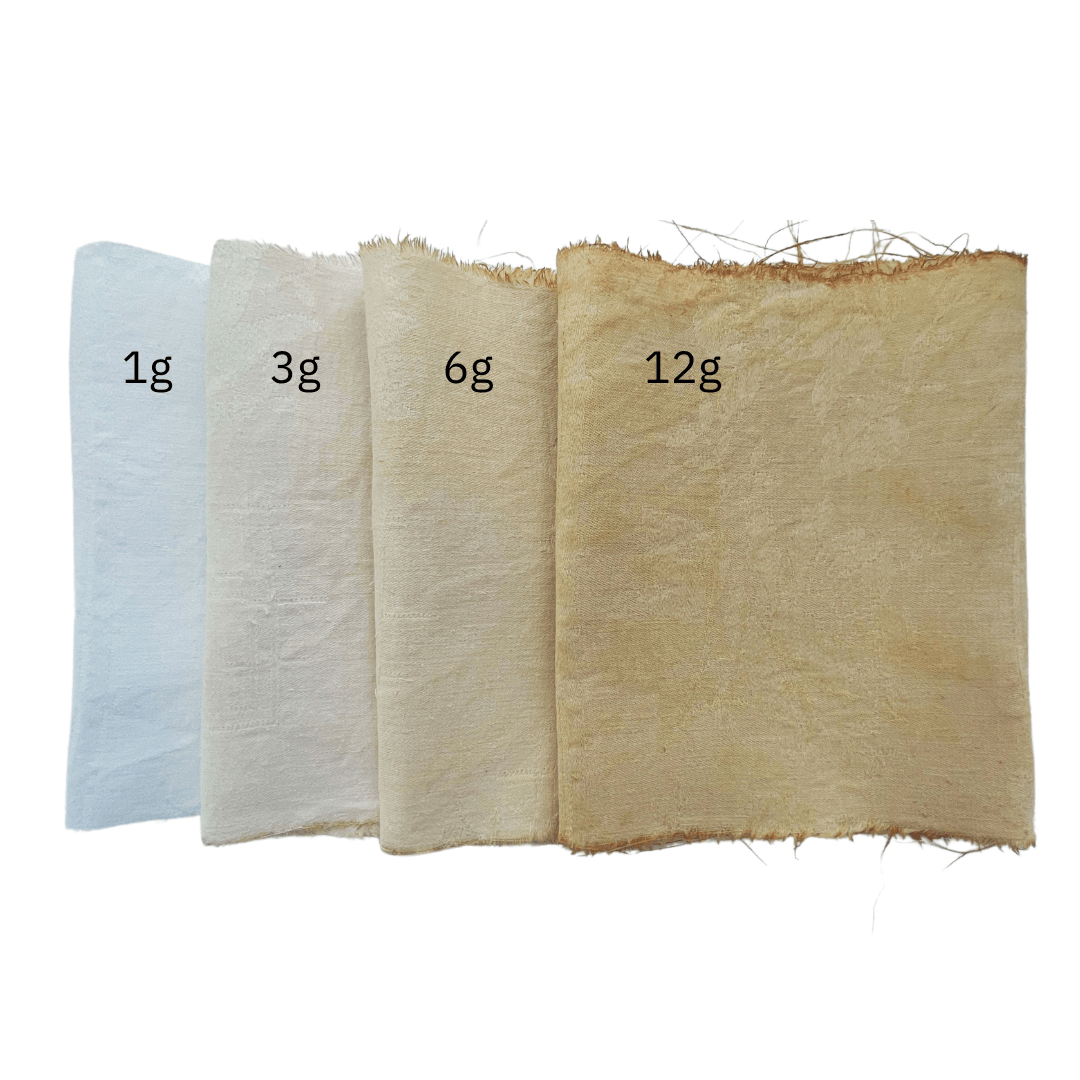
The image above illustrates this beautifully. As the amount of iron increases pr. liter of mordant, the fabric gradually shifts from a cool white tone toward warmer cream and yellow hues. Although no plants have been printed on these samples, they clearly demonstrate how strongly iron can influence the foundation upon which a botanical print is built.
This is one reason why I often choose different mordants depending on the aesthetic I wish to achieve. A bright, luminous background calls for a very different iron strategy than a darker palette.
The different ways iron can be introduced in the ecoprinting process
One of the fascinating things about iron is, that it can enter the ecoprinting process at several different stages.
Iron in the mordant
The most direct approach is to include iron as part of the mordant itself. In this case, the iron becomes integrated into the fabric before printing begins. This often creates strong definition and consistent results, because the iron is present throughout the entire textile.
The amount of iron can significantly influence both print clarity, definition and background color.
Iron dips
Iron can also be introduced through an iron dip before printing. This approach allows the fabric to be treated with iron shortly before the plants are arranged. Many practitioners use this method when they want greater flexibility in the process, or wish to adjust the amount of iron independently from the mordant.
Iron blankets
Another way of introducing iron to the print is via an iron blanket. Here, the iron is added to the print using a piece of fabric that acts as the carrier. It is applied much like a dye blanket, except that the fabric is soaked in an iron solution rather than a dye solution.
You can often recognize when an iron blanket has been used because it creates a darker outline around the plant shapes. This effect can be used deliberately, as it somewhat resembles shadows surrounding the plants.
This happens because the reaction between iron and tannin in the plants primarily occurs along the edges of the plants, where the tannins come into contact with the iron. Beneath the plants, the reaction is usually less pronounced, as the plants themselves act as a partial barrier, that prevents some of the iron from reaching the fabric.
Iron through plant material
Iron is also closely connected to the plants themselves. Some plants contain significant amounts of tannins and react strongly when iron is present, while others show only minor changes. For this reason, the same iron treatment may produce dramatically different results depending on the botanical material being used.
Another way of introducing iron is to apply it directly to the plants, for example by soaking them in an iron solution before printing. Make sure to remove any excess iron solution before printing, as the iron can otherwise bleed, and cause rust stains on the fabric.
Iron baths after printing
Some ecoprinters choose to modify a print after steaming by placing the textile in a post printing iron bath.
This can dramatically shift colors and increase contrast after the print has already developed.
Personally, this is not a technique I use in my own practice, as I prefer to build the iron into the process earlier, and allow those interactions to develop during printing.
Protein fibres vs. cellulose fibres and iron exposure
When working with iron in ecoprinting, it is essential to understand the type of fiber you are using and how it responds to iron.
Iron should always be used consciously and in moderation when working with protein fibers such as silk and wool.
Silk is particularly sensitive to iron because its protein structure contains amino acids with functional groups that readily bind metal ions. Over time, iron may promote oxidation of the protein structure, leading to a gradual loss of strength and elasticity. In high concentrations or after repeated treatments, the fabric can eventually become brittle.
Wool is also a protein fiber, but its structure is generally more complex and robust than that silk. This means that wool can often tolerate slightly higher levels of iron before damage becomes noticeable. Nevertheless, excessive use of iron or repeated treatments can still weaken the fiber, reduce its elasticity, and accelerate long-term deterioration.
Cellulose fibers, such as cotton and linen, are chemically more resistant to the effects of iron. Because cellulose does not bind iron as readily as protein fibers, these materials can generally withstand higher levels of iron before fiber damage occurs.
This does not mean that unlimited amounts of iron can be used. Rather, it highlights the importance of understanding both the chemistry of the fiber and the role iron plays within the printing process. The goal is always to use enough iron to achieve the desired effect, while preserving the long-term integrity of the textile.
More iron is not always better
A common misconception is that stronger prints simply require more iron. In reality, iron is all about balance.
Too little iron can result in prints that lack depth and definition. Too much iron can suppress color brightness, overwhelm delicate details and shift prints toward super dark, dusty or moody colors.
For this reason, I generally encourage systematic experimentation. The goal is not to use as much iron as possible. The goal is to understand how different levels of iron influence color, detail and overall expression, so that you can choose the effect intentionally.
Small adjustments in iron concentration can have a surprisingly large impact on the final result. Learning to recognize these differences allows you to make more informed decisions and develop a deeper understanding of how iron interacts with plants, dyes and fibers.
As with so many aspects of ecoprinting, testing and observation will often teach us far more than simply increasing the quantity of a particular ingredient.
Iron as a creative tool
The more I work with ecoprinting, the more I have come to see iron not simply as an ingredient, but as a creative tool.
It can sharpen. It can darken. It can reveal details that would otherwise remain hidden.
Too little iron may result in a print that lacks depth and definition. Too much iron may suppress some of the color nuances that make botanical printing so fascinating. Finding the right balance is therefore not simply a technical consideration - it is also an artistic one.
Whether introduced through a mordant, an iron dip, an iron blanket or directly through the plant material itself, iron has the ability to dramatically influence the final print.
And once you begin understanding how iron behaves within the printing process, an entirely new layer of possibilities opens up.