
Is ecoprinting and botanical printing really unpredictable?
I often hear people describe botanical printing as unpredictable. Some love that aspect of it, while others find it deeply frustrating. Personally, I understand both perspectives because, if I am honest, during my first years working with ecoprinting, I had a genuine love-hate relationship with the process.
I loved it because it felt magical, alive and full of possibilities to be able to print with nature. Every bundle seemed to contain the promise of discovering something entirely new. At the same time, however, I often found the process frustrating. Not because the plants themselves were unpredictable, but because I did not yet understand them. When a print failed to develop the way I had imagined, I assumed the process was random. It felt as though the plants had simply decided not to cooperate.
Looking back, I can see that what I was experiencing was not unpredictability. It was a lack of understanding.
The more I learned, the more predictable the botanical printing proces became
What I know today is that plant colors are far more predictable than many people believe. When we develop a fundamental understanding of plant dyes, fibres, mordants and printing conditions, and when we build a consistent practice, the process becomes remarkably reliable.
That does not mean every print becomes identical. We are still working with living materials. Plants change throughout the seasons, weather conditions influence their expression, and every bundle contains subtle variations. But the foundation becomes predictable, and that changes everything.
Does consistency kill creativity?
One of the biggest misconceptions I encounter is the idea that consistency somehow removes the magic from botanical printing. Some people worry that if we work more systematic, creativity will disappear.
My experience has been exactly the opposite.
Consistency creates freedom.
When I know how a particular result is achieved, I no longer have to start from scratch every time I want to create something similar. I don't have to rely on luck or guesswork. I understand which factors contributed to the result, how to recreate them if I wish, and how to build upon them when I want to explore new possibilities.
That frees up an enormous amount of creative energy. Instead of constantly troubleshooting the same technical challenges, I can focus on exploring new ideas, experimenting with new plants and developing my own artistic expression.
To me, working without consistency is a little like starting a knitting project without knowing the gauge, the yarn weight or the pattern. The outcome may be interesting, but it can also head in completely unexpected directions.
What consistency means to me
For me, consistency is not about rigidly repeating the same process. It is about understanding the variables that influence a print.
It begins with knowing my materials and understanding whether I am working with protein fibres or cellulose fibres. It involves choosing mordants that are capable of producing crisp, detailed prints and understanding how those mordants can be adjusted to create different color palettes and effects.
It means getting to know the different types of printers, and how they interact with the fibers throughout the different seasons (learn more about the different printers here).
It also means understanding how bundling methods influence print clarity and how moisture affects the bundle during steaming. Over time, I have learned the moisture requirements of the fabrics I work with most frequently, both as target fabrics and as blankets. Knowing exactly how much moisture is needed to achieve a full migration of background color while maintaining sharp botanical detail, has become one of the cornerstones of my practice.
The more familiar I become with these variables, the easier it becomes to intentionally create the effects I am looking for.
Consistency is built through experimentation
Perhaps the most surprising thing is that consistency is not the opposite of experimentation.
Consistency is built through experimentation.
Every print teaches us something, whether it turns out exactly as planned or not. In fact, some of my most valuable discoveries have emerged from experiments that initially felt unsuccessful.
When a print does not develop as expected, I do not see it as a failure. Instead, I see it as information. Why did the colors shift? Why did the print become blurry? Why did the background dye migrate differently than anticipated? Why did one plant perform beautifully while another barely left a trace?
Questions like these often lead to a deeper understanding of the process.
Over time, I have come to realise that every experiment becomes a stepping stone towards the next discovery. Even the less successful prints illuminate new paths to explore, new variables to test and new approaches to investigate. What initially appears to be a disappointing result often becomes the beginning of a new line of inquiry.
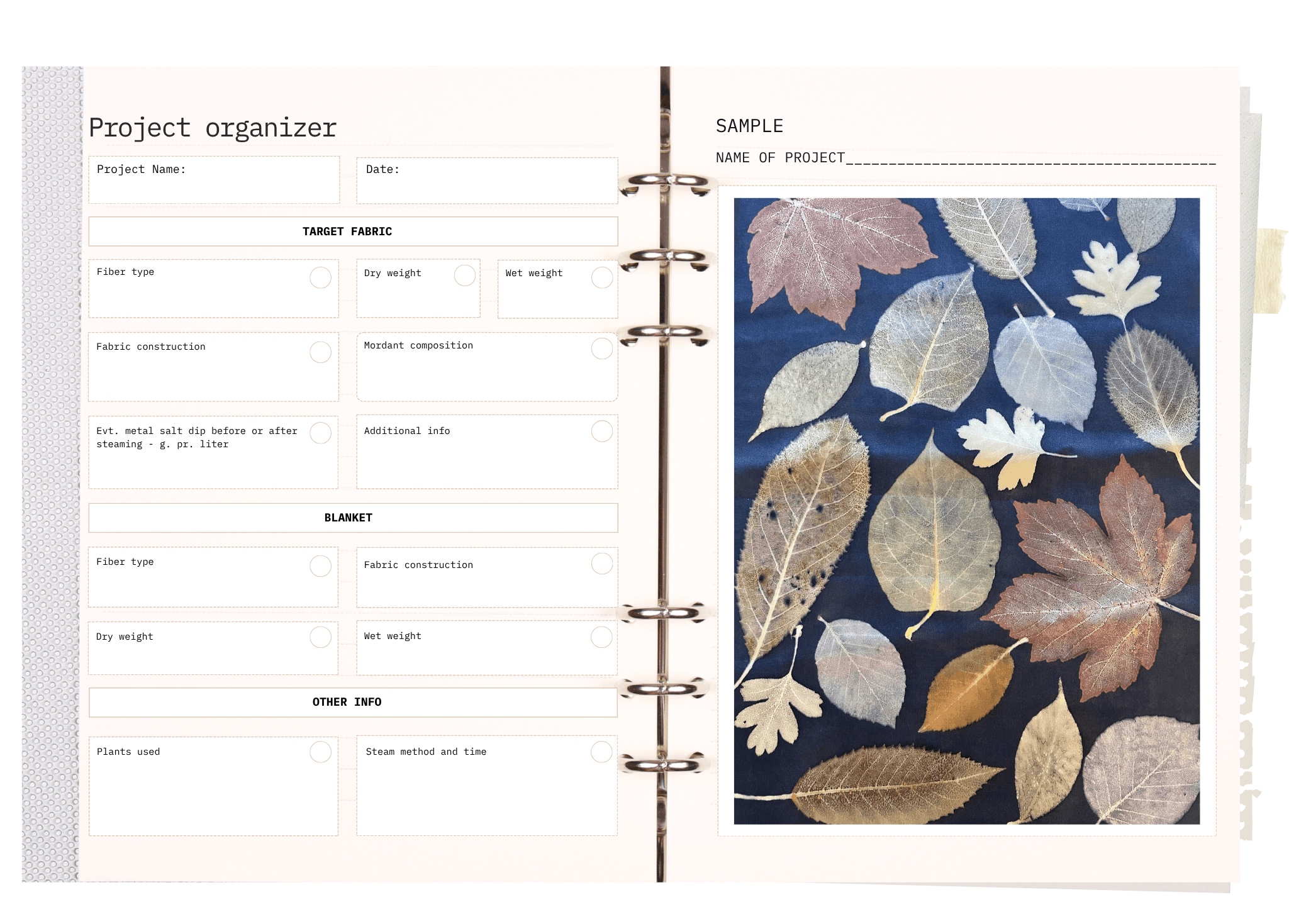
This is why I always encourage students to keep samples, take notes and document their results. A print log may not sound particularly exciting, but over time it becomes one of the most valuable tools you can have.
Creating your own botanical archive
One of the most important practices I have developed around my ecoprinting and botanical printing practise, is keeping detailed records of my experiments.
Whenever I test a new idea, I create samples, document the variables and keep detailed notes. Over time, this becomes a personal archive - a library of accumulated knowledge that I can return to again and again.
If I create a print I love, I know exactly how I arrived there. If a print does not work as expected, I can analyse it, learn from it and use that information to guide my next experiment.
Nothing is wasted.
Not the successful prints.
Not the ones that turned out differently.
Every sample becomes part of a larger body of knowledge, that continues to grow over time.
Botanical printing as a living process
Do I still think botanical printing is magical?
Absolutely.
Perhaps even more than I did in the beginning.
But today, the magic feels different.
It no longer comes from unpredictability. It comes from the endless complexity of working with living materials. The more I learn, the more I realise how much there is still left to explore: new plants, new color interactions, new combinations of fibres and dyes, and new questions waiting to be answered.
That is why I continue experimenting, because every print opens the door to the next adventure.
Create your own archive of botanical experiments
If you'd like inspiration for creating more consistent ecoprints and building your own archive of test results, I've created a free guide with log sheets that I use to document my experiments and observations.
Over time, it becomes an invaluable tool for tracking discoveries, identifying patterns, understanding why certain results occur and recreating the prints you love most.
➜ Download the Ecoprint Log Sheet and guide to consistency here.